
Empathy
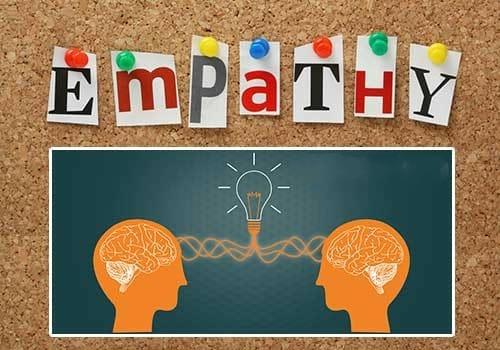
Empathy (from the Greek patho - empathy) is the ability of a person to enter into the emotional state of another person, empathizing and sympathizing with them. A person, from birth, is endowed with many opportunities for knowing the world, one of which is understanding others without the use of verbal interaction. In 1990, the Italian neurobiologist Giacomo Rizzolatti discovered the basic mechanism of such understanding. In the course of conducting a regular experiment observing the activation of certain areas of the brain in monkeys when performing simple actions, stunning results were obtained at that time. For example, when an experimental monkey took an object, a certain neural activity arose in the motor part of its brain, but the same neural activity arose even if the monkey simply observed the actions of someone else who took the object. And the same activity was observed even if the object was behind a screen, and someone in front of the monkey simply put his hand there, pretending to take this object. Thus, the scientist suggested that the secret of the mechanism of mutual learning and imitation, as well as empathy of living beings, had been revealed. In essence, in the mind of the observer of someone else's actions, this observed situation is reproduced. The neurons responsible for such interaction were called mirror neurons, since they are responsible for the mirror reflection of other people's actions through the living being's own actions. “In further research, mirror neurons were also found in the language, motor, visual, associative and other areas of the human brain, as well as in the solar plexus, the so-called “ventral brain”. And they work much more flexibly than in monkeys.” This revealed the secret of why we feel bad if we offend someone. What drives us to sacrifice our own time, goods, or comfort to help strangers? Our mirror neurons are responsible for the so-called appropriate response. Using the imitation mechanism, mirror neurons enable us to try on the behavioral patterns adopted in our environment. This is how a person's ability to express what they feel, as well as intuitively understand what another person feels, emerges. Understanding of another person's consciousness, empathy for the observed (or imagined) feelings of another, as well as for the experiences of characters in works of art, cinema, theater, and literature, arises. Empathizing, a person experiences feelings identical to those they observe. Why then do we have sympathy for some people and not for others? One of the reasons is that our neurons "mirror" only emotions and gestures that are understandable and familiar to us. But, even without striving for imitation, we still copy each other. It should be noted that empathy is a two-way phenomenon. In other words, in order to understand the hidden motives and desires of another person, you need to open up to him or her with a positive inner mood. And a fake, strained smile will not help in communication, because the interlocutor's mirror neurons, like your own, recognize falsehood, because they are able to perceive more subtle non-verbal signals. Giacomo Rizzolatti's colleague in the Vittorio Gallese research group drew attention to the fact that in children with autism, alienation, inability to communicate, is associated with a violation of the work of mirror neurons, which is why they cannot read the emotions of others, and therefore are unable to understand their meaning. Other researchers who deal with the problem of autism hold the same opinion. With the discovery of all these mechanisms, the causes of emotional and behavioral degradation in people who take alcohol or drugs were also revealed. It turns out that these substances do not just block the work of mirror neurons, but destroy them, which affects a person’s life in the most direct way. A person becomes unable to adopt behavioral mechanisms, and also loses the opportunity for personal development through intuitive perception of the environment. In essence, a person loses himself, and the longer the use of these substances continues, the more irreversible this loss will be. If a person completely stops drinking or using drugs, the body eventually recovers, and the person gets a chance for the spiritual development of his personality.