
-
Home page

-
Alter Ego Services
- Overcome your own fears and phobias
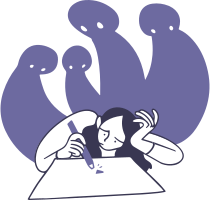
Overcome your own fears and phobias

Formats of holding: Online or In Person


What is a phobia?
A phobia is a type of mental disorder characterized by an excessive, unnatural, and unreasonable fear of a specific object, situation, action, or idea.
The most common phobias:
- Arachnophobia: Fear of spiders or other eight-legged animals.
- Agoraphobia: Fear of open or public places where it may be difficult to avoid a panic attack.
- Aviaphobia: Fear of airplanes or flying.
- Hemophobia: Fear of blood or medical procedures.
- Claustrophobia: Fear of closed or confined spaces.
- Social phobia: Fear of social situations or speaking in front of a group
people. - Emetophobia: Fear of vomiting or seeing someone vomit.
- Acrophobia: Fear of heights.
- Snake phobia: Fear of snakes or other reptiles.
- Automobile phobia: Fear of driving or riding in a car.
Signs of phobia:
- Intense fear: The person demonstrates excessive and disproportionate fear of a specific object, situation, or action.
- Avoidance: They avoid the object or situation that triggers their phobia, even if it creates significant difficulties in everyday life.
- Physical reactions: A person may experience physical symptoms of stress, such as increased heart rate, sweating, irritability, headache, dizziness, chest pain, shortness of breath, trembling, etc., when they are confronted with their phobia.
- Panic attacks: In some cases, a phobia can lead to panic attacks, which can include intense fear, dizziness, loss of control, chest pain, heavy breathing, etc.
- Significant discomfort: The phobia causes significant discomfort and interferes with daily functioning and social interactions.
Specialists who will help you



Adult
Individual
Couples consultation
Family consultation
Group consultation
Online/Offline
1 300 session

Adult
Individual
Couples consultation
Family consultation
Military
Online/Offline
2 500 session




Make a gift for yourself or your loved ones
-
 Choose the format and location
-
Specialist experience
-
And the desired amount
How does the first consultation
take place?
01
Introduction and discussion of the problem
The work begins with an initial interview, where the main tasks are defined and all framework conditions are agreed upon. For the initial interview, 1 to 4 meetings are required.
02
We outline a plan for further actions
We clarify our expectations from the consultations, the goals that can be achieved during the work. We will discuss the duration of the analysis and the frequency of meetings.
03
Understanding the scope of work and solution methods
Sometimes there is a need to solve one specific problem, but there is no need for a deep analysis. It may be the other way around. We will discuss this and come to a joint solution.


Work is done individually.

The session lasts about 50 minutes.

Payment in a convenient format: cash or online

Ability to work via Google Meet or Zoom

Working languages: Ukrainian, Russian and English by agreement

Postponement of consultation by 24 hours