

Maslow's pyramid of needs
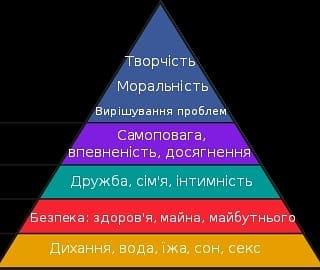
Maslow's pyramid of needs is a hierarchical system of human needs, compiled by the American psychologist, the founder of humanistic psychology Abraham Maslow. Investigating the factors that influence human behavior, he divided them into five categories and arranged them in a certain hierarchy. At the base of this hierarchy were the most urgent needs (food, water, shelter), and at the top - higher individual requests (recognition, self-expression). When the needs of the lowest level are satisfied at least partially, a person begins to move towards satisfying the needs of another and not necessarily the next level of the hierarchy. The first (lower) group of needs is vital (biological) needs. Their satisfaction is necessary to maintain human life, and dissatisfaction causes death. The second group is the need for security, their dissatisfaction causes human illness. The third group is the need for love and recognition from other people. The fourth is the need for self-esteem, self-respect. The fifth group is the needs of self-actualization (a higher level of development of human abilities).